
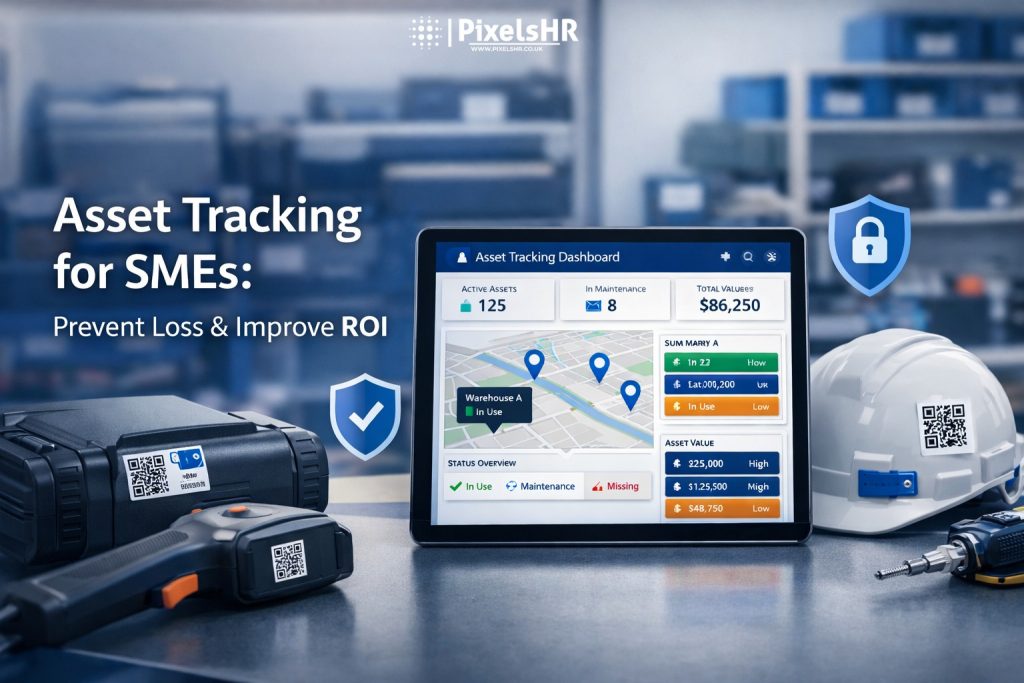
Asset Tracking in SMEs: Preventing Loss, Improving Accountability & ROI
Within the dynamic environment of today’s business world, small & medium businesses are generally operating with extremely small margins. The majority of businesses in this area are concentrated on transforming their business into a digital format and improving employee talent; however, many times they neglect a significant portion of their operations, which is the physical infrastructure which keeps their offices, warehouses and remote working environments.
PixelsHR believes that managing both workers and the tools that enable them to function effectively should be done together. As businesses grow, it becomes more difficult to keep up with the number of assets that have to be managed via a manual or mental method. As such, as small and medium businesses begin to grow, asset tracking for SMEs becomes more of a strategic advantage for growth, minimising loss and providing the company with long-lasting financial stability.
Stopping the “Invisible Leak”: Loss Prevention
The most immediate impact of a dedicated tracking system is the dramatic reduction in inventory shrinkage. In many SMEs, shrinkage isn’t necessarily the result of theft; more often, it is “administrative disappearance.” A laptop is left in a desk drawer of a departed employee, a tablet is borrowed for a weekend and never returned, or expensive tools are left at a job site.
By focusing on asset loss prevention, a business can stop the cycle of “emergency purchasing.” When you lack visibility, your default reaction to a missing item is to buy a new one. This wastes capital and leads to “ghost assets” items that appear on your financial books but do not exist in reality. This discrepancy causes you to overpay on insurance premiums and taxes.
Tracking the Missing Pieces
By tracking missing assets with a digital ledger, you ensure that every dollar spent on equipment continues to provide value. Modern inventory shrinkage solutions allow managers to see real-time data. If a piece of equipment hasn’t been scanned or checked in for 30 days, the system triggers an alert. This proactive approach allows you to recover items before they are gone for good.
Furthermore, the psychological impact is significant. When employees know there is a formal system for tracking missing assets, a culture of care emerges. It signals that the company values its resources, which encourages staff to treat equipment with higher levels of respect.
Also Read: Flexible From Day One: The Future of Work Becomes Law
Building a Culture of Accountability
One of the greatest challenges in SME management is fostering a sense of ownership. As headcount increases, the “tragedy of the commons” sets in. If everyone is responsible for shared equipment, then no one is. Integrating employee accountability tools into your daily workflow changes this dynamic entirely.
- The Digital Handshake
By utilising equipment check-in check-out software, you create a transparent “chain of custody.” This isn’t about micromanaging; it is about creating a clear record. When a field engineer scans a tool out of the storeroom, the system records the transaction instantly.
This asset custody tracking provides a “digital handshake” that protects both the company and the employee. If an item returns damaged, the manager knows exactly who to speak with. Conversely, the employee is protected from blame for items they never actually possessed.
- Offboarding and Compliance
This level of detail is crucial for small business asset management during the offboarding process. One of the most common ways SMEs lose money is by failing to recover hardware from departing employees. An automated system tied to HR ensures that no final exit interview is complete until the “digital locker” of that employee is cleared.
Also Read: 5 Proven Strategies for Efficient Timesheet Management Using PixelsHR
Maximising Your Return on Investment (ROI) (inf)
The most common pushback from SME owners regarding tracking software is the cost. However, a deep dive into asset tracking ROI reveals that the software usually pays for itself within months.
- Eliminating Redundant Procurement
How many times has your office manager ordered new monitors because they thought the supply was empty, only to find a stack of them in a closet three months later? Small business asset management provides a “single source of truth,” preventing unnecessary spending.
- Maintenance and Lifecycle Extension
Assets that are tracked are assets that are maintained. By setting alerts for routine maintenance, you move from a “run-to-fail” model to a preventative one. This maximizing asset lifecycle approach ensures that a $2,000 server lasts five years instead of three, directly impacting the bottom line.
- Improving Operational Efficiency
Consider the man-hours lost every month by employees searching for misplaced items. Whether it’s a specific cable, a shipping palette, or a backup drive, those minutes add up to thousands of dollars in lost productivity. Improving operational efficiency means your team spends their time working, not playing detective.
Also Read: Role of HR Document Software in Managing Employee Leave and Absence
Choosing the Right Technology
Modern affordable tracking solutions are no longer reserved for Fortune 500 companies. Today’s SMEs can choose from various technologies that fit their specific scale.
| Technology | Best For | Benefit |
| QR Codes | Office supplies, Laptops | Low cost, works with mobile asset tracking apps. |
| RFID | High-volume warehouses | Scans multiple items at once without line-of-sight. |
| GPS Tracking | Vehicles, Heavy machinery | Real-time location data and theft recovery. |
| Cloud Systems | Remote & Hybrid teams | Accessible from anywhere, it ensures data sync. |
QR Code vs RFID for SMEs
For most office-based SMEs, QR codes are the best entry point. They can be printed on durable stickers and scanned with any smartphone. For businesses dealing with high volumes of moving parts, such as a construction firm, RFID allows for “passive tracking,” where items are logged as they pass through a gateway.
Also Read: Safer Workplaces in 2025: New Anti-Harassment Duties Every Employer Must Meet
The Role of Cloud and Mobile
The shift to the cloud has been a game-changer for scalable asset software for growth. A cloud-based system ensures that the data is accessible from anywhere. If a branch manager in another city adds a new laptop, the head office sees it instantly.
By using mobile asset tracking apps, you put the power of the database in the pocket of every employee. If a technician is at a remote site and notices a tool is broken, they can take a photo and update the status immediately. This reduces the friction of data entry, which is the number one reason why manual spreadsheets fail.
Strategy: Implementing an Asset Workflow
To see a high cost-benefit of asset management, you must treat implementation as a process, not just a software install.
- The Audit: Start by tagging every high-value item. This sets your baseline.
- Assign Ownership: Every asset should be assigned to a person, a department, or a location.
- Automated Audit Trails: Use software that generates logs automatically. This is vital for improving accountability and preparing for financial tax audits.
- Integration: Connect your asset tracking to your HR platform (like PixelsHR) to ensure that employee data and asset data are always in sync.
Why SMEs Need Scalable Solutions
Many small businesses make the mistake of using “free” tools like Google Sheets. While this works for ten laptops, it fails at fifty. As you grow, you need scalable asset software for growth that can handle complex data, such as depreciation schedules and lease agreements.
A robust system provides automated audit trails that are essential if you ever plan to seek investment or sell your business. Investors want to see that your “Property, Plant, and Equipment” (PP&E) accounts are accurate and well-managed.
Industry-Specific Use Cases
Listed below are some of the industry-specific use cases:
- The Creative Agency
For an agency, cameras, lenses, and high-end tablets are the tools of the trade. These items move frequently between creators and locations. Using equipment check-in check-out software ensures that expensive gear doesn’t “walk away” after a video shoot.
- The Construction Firm
On a construction site, tools are often shared. GPS asset tracking and RFID tags help the site manager know if the specialised drills are at Site A or Site B, reducing the need to rent duplicate equipment.
- The Professional Service Firm
Even in a pure office environment, assets like ergonomic chairs, specialised software licenses, and standing desks represent a high cost. Small business asset management helps track these items across multiple floors or home offices.
Common Pitfalls to Avoid
Here are some common pitfalls to avoid:
- Tracking Too Much: Don’t waste time tracking pens and staplers. Focus on items over a certain dollar value (e.g., $50 or $100).
- Lack of Training: If employees don’t know how to use the mobile asset tracking apps, they won’t use them. Keep the process simple.
- Forgetting Maintenance: Tracking isn’t just about location; it’s about health. Use your system to schedule repairs to ensure you are maximizing asset lifecycle.
Also Read: Improving Employee Onboarding with HR Document Management Systems
Final Thoughts
In conclusion, asset tracking for SMEs is the silent engine of a well-run company. It bridges the gap between the finance department, the IT team, and the general workforce. By prioritising asset loss prevention and seeking out affordable tracking solutions, business owners can reclaim lost time and capital.
Whether you are looking to improve your asset tracking ROI or simply want to stop the frustration of missing equipment, the solution lies in moving away from manual logs and toward a digital, automated future. At PixelsHR, we believe that managing your people and your tools go hand-in-hand. By improving operational efficiency through smart tracking, you aren’t just counting equipment; you are building a foundation for a more disciplined, profitable, and professional organisation.
Start tracking today, and turn your “missing” items into your next big investment.
FAQs
Spreadsheets are prone to human error and lack real-time updates. Dedicated asset tracking for SMEs offers automation, cloud accessibility, and precise audit trails. It eliminates “ghost assets” and provides instant visibility into who has what, ensuring your data is always accurate as your business scales beyond manual management capabilities.
By using equipment check-in check-out software, you create a transparent chain of custody. When employees scan an item, they acknowledge responsibility for its condition and location. This “digital handshake” reduces negligence and ensures that asset custody tracking is maintained, fostering a culture of professional stewardship and individual ownership.
You see an immediate asset tracking ROI by eliminating redundant purchases. When you know your exact inventory levels, you stop buying equipment you already own but can’t find. Additionally, maximising asset lifecycle through scheduled maintenance prevents expensive emergency repairs and extends the usable life of high-value hardware.
Yes. There are many affordable tracking solutions designed specifically for smaller budgets. Using mobile asset tracking apps allows staff to use their own smartphones as scanners, removing the need for expensive proprietary hardware. Scalable, cloud-based subscriptions mean you only pay for the number of assets you actually track.
Integrated small business asset management ensures no equipment is left behind when a staff member departs. By pulling an automated audit trail of all items assigned to that individual, HR can verify the return of laptops, keys, and peripherals, effectively preventing “administrative loss” during the sensitive offboarding phase.