Talent Pipeline Optimization: Using HR Software to Improve Recruitment & Hiring Quality
As we near 2026, the growing number of companies competing for the same candidates has made the ‘post and pray’ approach to recruiting obsolete. Instead of recruiting reactively, companies now need to focus on creating a Talent Pipeline Optimization strategy to attract and build a talented workforce through qualified candidates at the time they become available. A Talent Pipeline Optimisation approach allows the organisation to take advantage of large candidate pools by proactively locating and recruiting qualified candidates as the need for new talent arises in the organisation.
HR departments today are tasked with more than just filling job vacancies; they must also build and maintain a healthy workforce of qualified candidates ready to fill any vacancy immediately upon posting. New technology, such as sophisticated HR software solutions, has also changed how candidates are recruited today by removing the burden of hiring and providing companies with a greater benefit through the strategic use of technology in recruiting and hiring.
This PixelsHR Talent Pipeline Optimisation Guide will help companies use technology to maximise their talent pipeline and ensure that their recruitment process produces higher-quality candidates.
What is Talent Pipeline Optimization?
Talent Pipeline Optimization is the strategic process of streamlining how you identify, engage, and nurture potential candidates before a specific role even becomes available. Unlike a traditional talent pool, which is often a static database of past applicants, an optimised pipeline is a dynamic, “living” ecosystem of talent.
At its core, an optimised pipeline addresses the “skills gap” by ensuring that the recruitment engine is always running. By utilising talent acquisition automation, companies can maintain constant engagement with “silver medalists” (high-quality candidates who narrowly missed previous roles) and passive talent who may not be actively looking but are open to the right opportunity.
The Shift from Reactive to Proactive
Reactive hiring is expensive. It often leads to rushed decisions, increased cost-per-hire, and lower retention rates because the priority is “speed” over “fit.” Pipeline optimization flips this script. By the time a requisition is raised, your HR software should already have a list of pre-vetted, engaged candidates who have been nurtured through your employer branding efforts.
Also Read: HR Software Adoption Failure: 7 Tips for SME Digital Success
The Role of HR Software in Modern Recruitment
The days of tracking candidates via spreadsheets are over. To maintain a competitive edge, organisations must integrate an Applicant Tracking System (ATS) that does more than just store resumes. Modern HR software for recruitment serves as the central nervous system of your talent strategy.
1. Eliminating Manual Bottlenecks
Recruitment workflow optimization starts with removing repetitive tasks. Automation tools can now handle:
- Job Distribution: Posting to multiple job boards and social media channels with a single click.
- Interview Scheduling: Synchronising with recruiters’ calendars to allow candidates to pick their own slots, eliminating the back-and-forth of emails.
- Automated Communication: Keeping candidates informed at every stage, which significantly boosts the candidate experience.
2. Intelligent Candidate Screening
One of the biggest hurdles in talent acquisition is the sheer volume of applications. Candidate screening tools powered by AI can now parse resumes with incredible precision. Rather than just looking for keywords, these tools use “explainable AI” to rank candidates based on skills, experience, and potential fit, providing recruiters with a “score” that justifies the ranking.
Also Read: HR Document Software for Small Businesses: Is It Worth the Investment?
5 Steps to Optimize Your Talent Pipeline Using HR Software
Optimizing your pipeline is a multi-stage journey. Here is how you can use technology to ensure you’re always one step ahead.
Step 1: Forecast and Plan with Data
Before you can build a pipeline, you need to know where your company is going. Use your HRIS (Human Resources Information System) data to identify turnover trends and upcoming retirement gaps. Data-driven hiring strategies allow you to forecast which departments will need talent in the next 6–12 months, allowing you to start sourcing early. This forward-looking approach ensures that HR is a business partner rather than just a support function.
Step 2: Leverage Talent Acquisition Automation for Sourcing
Don’t wait for candidates to come to you. Use automation to “scrape” professional networks and internal databases for profiles that match your “ideal candidate persona.” Many ATS platforms now offer “passive candidate tracking,” which alerts you when a high-potential individual in your network updates their profile or changes their status. Automation can also manage “boomeranging”, reaching out to high-performing former employees who may be ready to return.
Step 3: Implement Advanced Candidate Screening Tools
To ensure hiring quality improvement, you must move beyond the resume. Integrate skill-based assessments directly into your application flow.
- Soft Skills Testing: Use AI-driven video assessments to gauge communication and cultural alignment.
- Technical Challenges: For specialised roles, automated coding or logic tests provide objective data on a candidate’s ability.
- Cognitive Ability Tests: Assessing how a candidate solves problems in real-time, which is a stronger predictor of job performance than years of experience.
Step 4: Nurture with “Always-On” Engagement
A pipeline is only useful if the candidates are still interested when you call. Use your CRM (Candidate Relationship Management) features to send automated, personalised content. This keeps your brand “top of mind.” This could include:
- Quarterly company newsletters highlighting growth.
- Invitations to webinars or “meet the team” events.
- Updates on the company’s latest CSR (Corporate Social Responsibility) projects or awards.
- Personalised “check-ins” triggered by the system on work anniversaries or holidays.
Step 5: Audit the Workflow for Friction
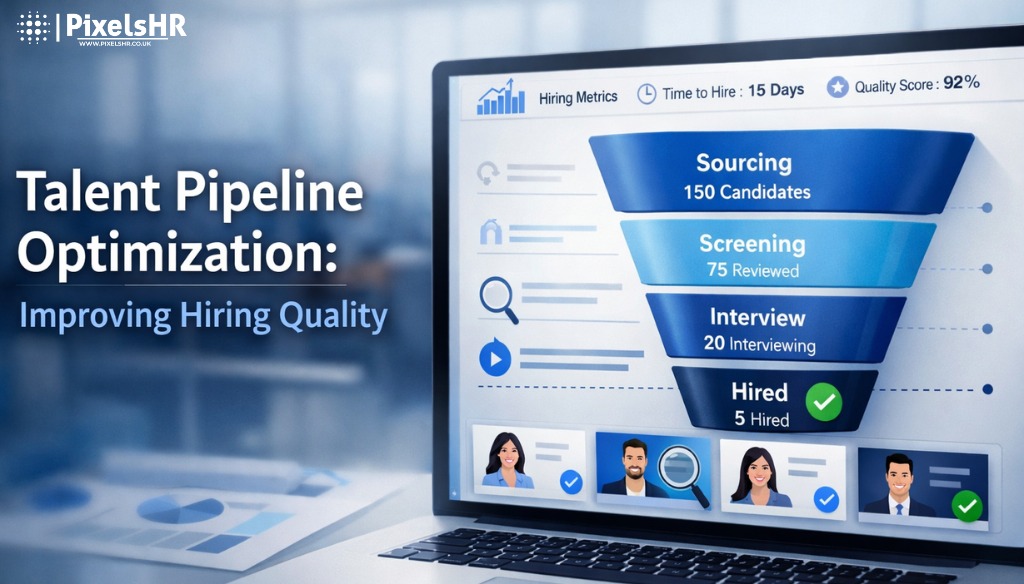
Use the analytics dashboard in your Applicant Tracking System (ATS) to find where candidates are dropping off. If 40% of candidates abandon the application at the “testing” phase, your screening might be too long or poorly designed. Recruitment workflow optimization is an iterative process of removing these friction points. By analysing the “time-in-stage” metric, you can identify which hiring managers are causing delays and provide them with the support or training they need to move faster.
Also Read: The Importance of Implementing an Effective Employee Leave Management System
Enhancing the Candidate Experience through Technology
A major component of Talent Pipeline Optimization is the Candidate Experience (CX). In a digital-first world, top-tier talent expects a seamless, transparent, and mobile-friendly application process.
- The Mobile-First Approach
High-quality talent often browses job opportunities during commutes or breaks. If your HR software for recruitment requires a desktop to upload a PDF and fill out twenty manual fields, you will lose the best talent to competitors. Modern ATS platforms offer “one-click apply” and mobile-responsive portals that allow candidates to manage their applications from their smartphones.
- Transparency and Feedback Loops
One of the most common complaints in recruitment is the “black hole”, where candidates apply and never hear back. Talent acquisition automation solves this by sending automated status updates. Even a rejection, if delivered promptly and professionally, leaves a better impression of your brand than silence. This maintains the health of your pipeline; a rejected candidate today might be the perfect fit for a different role next year.
Also Read: Role of HR Document Software in Managing Employee Leave and Absence
The Core Benefits of an Optimized Talent Pipeline
When you move from reactive to proactive hiring, the impact is felt across the entire organisation:
| Feature | Impact on Recruitment | Business Outcome |
| Automation | Reduces time spent on admin by up to 60%. | Faster Time-to-Hire & lower overhead. |
| AI Screening | Minimises unconscious bias by using objective data. | Increased Diversity & Hiring Quality. |
| Talent CRM | Maintains a “warm” pool of pre-vetted candidates. | Lower Cost-per-Hire and instant access. |
| Data Analytics | Identifies the most effective sourcing channels. | Optimised Recruitment Budget and ROI. |
Improving Hiring Quality with Data-Driven Strategies
The ultimate goal of Talent Pipeline Optimization is to ensure that every hire is a “quality hire.” In 2026, data-driven hiring strategies are the primary differentiator between successful firms and those struggling with high turnover.
Measuring Quality of Hire
HR software allows you to track metrics that go far beyond the start date. By integrating recruitment data with performance management data, you can see:
- First-year Retention: Are the candidates you’re hiring staying?
- Performance Scores: Do candidates from certain sources consistently outperform others?
- Hiring Manager Satisfaction: How well did the software-vetted candidates meet the team’s needs?
By tracking these metrics, your candidate screening tools can be calibrated. For example, if data shows that candidates with a specific certification outperform those with a specific degree, the software can automatically prioritise that certification in future screenings.
Also Read: Improving Employee Onboarding with HR Document Management Systems
Overcoming Common Implementation Challenges
While the benefits are clear, moving to a software-driven pipeline model isn’t without hurdles. Success requires a change in mindset from both recruiters and management.
- Data Integrity
Your Applicant Tracking System (ATS) is only as good as the data entered into it. HR teams must be trained to tag candidates correctly and move them through the system accurately. Without clean data, “automation” can lead to embarrassing errors, such as sending the wrong email to a high-value prospect.
- Balancing AI and the Human Touch
The goal of talent acquisition automation is to free up recruiters to do what they do best: build relationships. There is a risk of over-automating to the point where the process feels cold and robotic. The most optimised pipelines use software for the logistics (screening, scheduling, sorting) and humans for the persuasion (culture-matching, negotiation, and vision-casting).
Choosing the Right HR Software for Your Pipeline
Not all software is created equal. To truly optimise your pipeline, look for these “must-have” features in your next ATS or HRMS:
- Multi-Agent AI: Systems that can handle screening, scheduling, and basic candidate queries simultaneously.
- Native Integrations: Your recruitment software should talk to your payroll, background check, and onboarding systems without manual data entry.
- Predictive Analytics: Tools that suggest who to hire based on historical success patterns within your company.
- Global Compliance: As remote work remains a staple, your software must be able to handle GDPR, CCPA, and local labour laws across different regions automatically.
Conclusion
Talent Pipeline Optimization is no longer a luxury reserved for Fortune 500 companies with massive HR budgets; it is a strategic necessity for any business that wants to grow in a competitive, skill-driven market. By embracing HR software for recruitment and shifting toward data-driven hiring strategies, you can significantly reduce your recruitment costs while achieving a substantial hiring quality improvement.
The secret to a great workforce isn’t finding the right person today; it’s having already found, nurtured, and engaged them six months ago. By building a technology-backed pipeline, you ensure that your organisation is never caught off guard by a vacancy, but is instead always ready to welcome the next generation of talent.
Ready to transform your recruitment? Contact us today to discover how our software delivers elite Talent Pipeline Optimization for your business.
FAQs
By using objective candidate screening tools and predictive analytics, HR software removes gut-feeling bias, ensuring candidates are selected based on proven skills, cultural alignment, and long-term performance potential.
An ATS centralises candidate data, automates repetitive scheduling, and streamlines communication. This allows recruiters to focus on building relationships rather than managing spreadsheets, significantly accelerating the entire hiring cycle.
With 2026’s competitive labour market, automation ensures you engage passive talent instantly. It maintains a “warm” pipeline without manual effort, preventing high-quality candidates from being lost to faster-moving competitors.
Optimizing your workflow identifies bottlenecks and high-performing sourcing channels. By reducing the “Time-to-Fill” and focusing budgets on platforms that yield the best results, organisations significantly lower their overall cost-per-hire.
Yes. By analysing historical performance data, software identifies traits common in long-term employees. This allows HR to prioritise candidates whose profiles suggest they will thrive and stay within the company.